
 Kody Nexov
 Published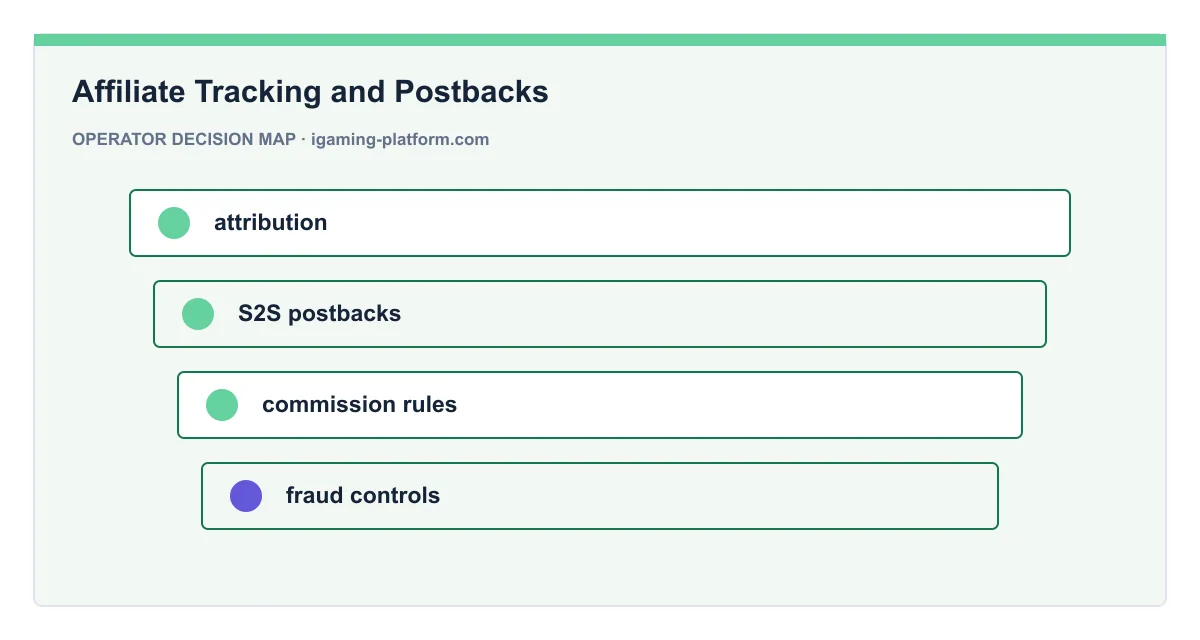
Research-backed decision brief - checked 2026-07-24
Affiliate Tracking and Postbacks: the decision-ready answer
A useful buyer guide must define the decision, system boundary, options, evidence standard, failure modes, retained responsibilities, total cost, implementation gates, and next specialist step. Definitions alone do not support a procurement decision.
The assigned US English query igaming platform architecture was checked on July 24, 2026. The result pattern was used to validate the page intent and question set.
Evidence standard for this decision
Use Yes only when a current source or test explicitly supports the field; Partial when it supports only part of the scope; Not found when the reviewed public sources do not expose it; and Unknown when it has not yet been evaluated. Not found is not evidence that a capability is absent.
| Decision field | Evidence to request | Pass signal | Keep unresolved when |
|---|---|---|---|
| Decision boundary | Named buyer, operating model, product layer, market, and decision | The reader can tell what this guide includes and excludes | The topic is treated as one undifferentiated product |
| Options | Comparable delivery models and responsibility boundaries | Trade-offs are tied to operator capability and constraints | One model is labelled best for everyone |
| Proof | Primary sources, versioned supplier evidence, tests, and contracts | Claims and unknowns are visibly separated | Marketing language is repeated as fact |
| Action | Requirements, acceptance scenarios, owners, and next guide | The reader can create a shortlist or test plan | The page ends with contact us |
Questions observed in current demand
The questions below combine the assigned search intent with the evidence gaps found in the current page review.
What is Affiliate Tracking and Postbacks, who is it for, and which decision should this page help make?
A useful buyer guide must define the decision, system boundary, options, evidence standard, failure modes, retained responsibilities, total cost, implementation gates, and next specialist step. Definitions alone do not support a procurement decision. Apply that evidence rule specifically to Affiliate Tracking and Postbacks and keep unverified product, price, market, and performance claims marked as unknown.
Question source: archetype - hub / buyer guide
Which components, roles, workflows, and dependencies define the topic?
A useful buyer guide must define the decision, system boundary, options, evidence standard, failure modes, retained responsibilities, total cost, implementation gates, and next specialist step. Definitions alone do not support a procurement decision. Apply that evidence rule specifically to Affiliate Tracking and Postbacks and keep unverified product, price, market, and performance claims marked as unknown.
Question source: archetype - hub / buyer guide
Which options or operating models should a buyer compare?
Answer it for a defined operator profile. Compare only like-for-like options, apply one evidence rule, and leave supplier-specific unknowns open until they are closed by current documentation, testing, references, or contract terms.
Question source: archetype - hub / buyer guide
Acceptance scenarios
- Use the guide to write a one-page requirement brief without relying on an unstated product assumption.
- Convert the principal risks into acceptance tests with owners and evidence outputs.
- Follow the linked research and specialist pages until every unresolved field has a verification route.
Source boundary and next evidence
The linked study is the direct research source for this page's topic cluster. It publishes the sample or control set, field definitions, classifications, checked date, primary-source ledger, limitations, and downloadable data. It does not replace jurisdiction-specific legal advice, a supplier proposal, authenticated documentation, a production test, customer references, or a signed contract.
Read the platform architecture research study or download its CSV dataset.
Decision in brief
Evaluate attribution, S2S events, commission logic, and reconciliation. The useful comparison is not the longest feature list. It is the combination of operator fit, verifiable evidence, implementation ownership, measurable service levels, and a workable exit path.
What this guide covers
Evaluate attribution, S2S events, commission logic, and reconciliation. It is written for affiliate managers, data teams, finance, and engineers. The goal is to turn an early market question into requirements that a buying team can verify during discovery, demos, technical review, commercial negotiation, and implementation planning.
This site evaluates platform architecture and module integration. Commercial provider reviews and generic solution rankings belong on igaming-solution.com.
| Area | Evidence to request | Decision owner |
|---|---|---|
| attribution | Request current documentation or a live workflow showing how attribution is configured, monitored, exported, and supported in production. | Product / operations |
| S2S postbacks | Request current documentation or a live workflow showing how s2s postbacks is configured, monitored, exported, and supported in production. | Technology / compliance |
| commission rules | Request current documentation or a live workflow showing how commission rules is configured, monitored, exported, and supported in production. | Product / operations |
| fraud controls | Request current documentation or a live workflow showing how fraud controls is configured, monitored, exported, and supported in production. | Technology / compliance |
| reconciliation | Request current documentation or a live workflow showing how reconciliation is configured, monitored, exported, and supported in production. | Product / operations |
Evaluation checkpoints
1. Confirm ownership and operator control of attribution
Define the expected outcome, request proof from the current product, record exceptions, and assign an owner for acceptance.
2. Test integration and data access for s2s postbacks
Define the expected outcome, request proof from the current product, record exceptions, and assign an owner for acceptance.
3. Review compliance and audit evidence for commission rules
Define the expected outcome, request proof from the current product, record exceptions, and assign an owner for acceptance.
4. Put commercial assumptions and exceptions in writing
Define the expected outcome, request proof from the current product, record exceptions, and assign an owner for acceptance.
Implementation sequence
- Define scope and exclusions. Document the operator profile, target market, delivery model, required integrations, and responsibilities that cannot be outsourced.
- Collect comparable evidence. Use the same scenarios and data requests for every candidate. Separate shipped capability from roadmap commitments.
- Run a solution and risk review. Trace critical workflows across product, technology, payments, compliance, operations, finance, and support.
- Convert findings into acceptance criteria. Put dependencies, owners, service levels, data access, timelines, and remedies into the implementation plan and contract.
- Plan controlled go-live and exit. Test degraded modes, reconciliation, incident escalation, rollback, data export, and transition support before production launch.
Questions to put in the RFP
- Show the production workflow and documentation for attribution. Which parts are standard, configurable, third-party, or roadmap-only?
- Show the production workflow and documentation for s2s postbacks. Which parts are standard, configurable, third-party, or roadmap-only?
- Show the production workflow and documentation for commission rules. Which parts are standard, configurable, third-party, or roadmap-only?
- Show the production workflow and documentation for fraud controls. Which parts are standard, configurable, third-party, or roadmap-only?
- Show the production workflow and documentation for reconciliation. Which parts are standard, configurable, third-party, or roadmap-only?
- Which operator teams and external suppliers must participate in implementation, testing, and ongoing operation?
- Which data can the operator access in real time, export in bulk, and retain after termination?
- Provide measurable service levels, escalation paths, maintenance rules, and recent incident examples relevant to this scope.
Red flags
- A broad feature claim without versioned documentation or production evidence.
- An integration dependency with no named owner, test plan, or service level.
- Commercial terms that hide third-party fees, minimums, or transition cost.
Frequently asked questions
What should a buyer verify first when evaluating affiliate tracking and postbacks?
Start with the operating model and the evidence behind attribution. A feature list is not enough: confirm ownership, configuration limits, implementation dependencies, and the exact production version being offered.
Which teams should review affiliate tracking and postbacks?
Affiliate managers, data teams, finance, and engineers should review the decision together. Product fit, technical feasibility, compliance accountability, commercial terms, and day-to-day operations are connected and should not be approved in isolation.
How should vendor claims be compared?
Use the same requirement matrix, evidence standard, and scoring scale for every vendor. Mark unsupported, roadmap-only, or market-specific claims separately instead of treating them as available capability.
What belongs in the contract or implementation plan?
Document scope, acceptance evidence, dependencies, owners, service levels, data access, change control, and exit support. Any requirement tied to reconciliation should have a named owner and testable acceptance criterion.
Concept map
Related concepts and decision guides
- affiliate platforms
- Affiliate platforms are a critical growth component for iGaming operators, acting as the technical bridge between traffic acquisition partners and backend financial systems.
- iGaming Platform System Map
- Assign platform boundaries, systems of record, interface owners, acceptance evidence, and degraded-mode questions.
- iGaming Software Modules
- Evaluate platform modules separately while preserving end-to-end workflow, data, and operational ownership.
- Bonus Engine Rules and Controls
- Design bonus rules that remain understandable, testable, and auditable.
- Player Wallet Architecture technical guide
- Assess ledger integrity, multi-currency, rollback, reconciliation, and wallet APIs.
Evidence layer
Primary references and verification limits
Sources were checked on . They support the standards and verification questions used in this guide. They do not prove a supplier-specific price, market eligibility, implementation result, or private product claim; buyers should request current, versioned evidence for those points.
- iGaming Platform - platform architecture research 2026 Original publisher research. A dated methodology, evidence matrix, primary-source ledger, limitations, and downloadable CSV supporting this page's decision framework.
- AWS Well-Architected — Reliability Pillar Cloud architecture guidance. Availability targets, resilience testing, incident learning, recovery objectives, capacity, and dependency management.
- NIST Cybersecurity Framework 2.0 Government standards body. Cybersecurity governance, risk management, protection, detection, response, and recovery outcomes.
- UK Gambling Commission — Remote gambling and software technical standards Regulator. Remote gambling software controls, security requirements, player-facing technical controls, and jurisdiction-specific verification questions.
- UK Gambling Commission — Testing strategy for remote gambling software Regulator. Testing, release control, audit evidence, change management, independent review, and production assurance questions.