
 Kody Nexov
 Published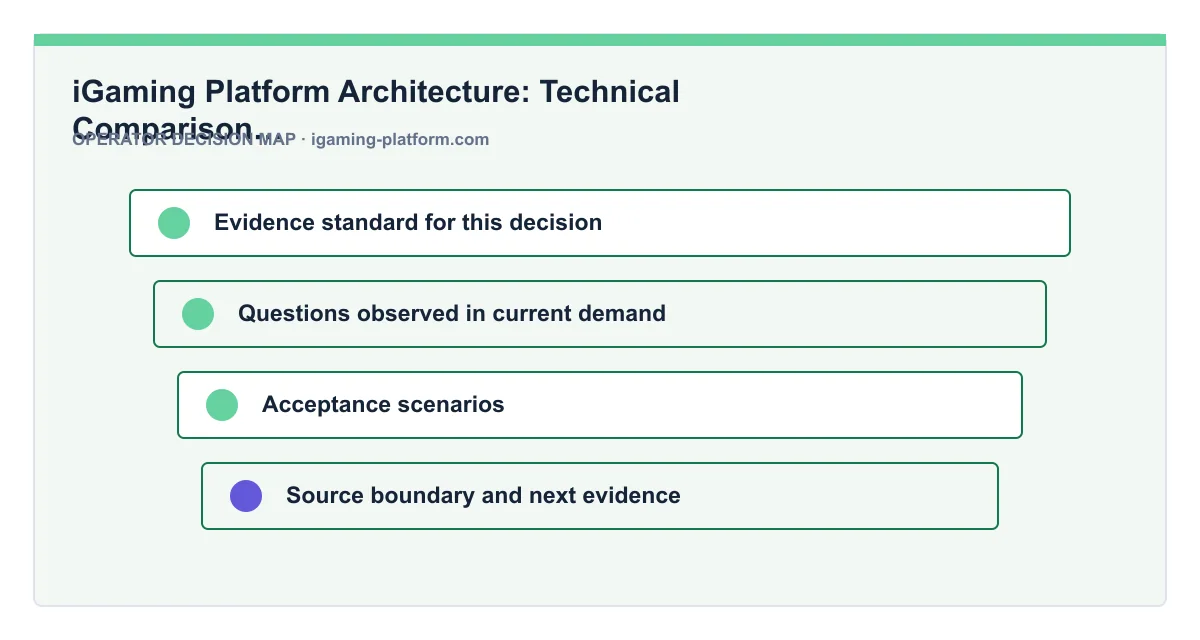
Research-backed decision brief - checked 2026-07-24
iGaming Platform Architecture: Technical Comparison & Operational Trade-Offs: the decision-ready answer
Start with the system boundary and data flow, then verify interfaces, identity, versioning, latency, capacity, failure handling, reconciliation, observability, recovery, and ownership. A component name or architecture diagram is not implementation evidence.
The assigned US English query best igaming platform providers was checked on July 24, 2026. The result included People also ask, so concise answer structure and explicit source boundaries matter for both search and answer engines.
Evidence standard for this decision
Use Yes only when a current source or test explicitly supports the field; Partial when it supports only part of the scope; Not found when the reviewed public sources do not expose it; and Unknown when it has not yet been evaluated. Not found is not evidence that a capability is absent.
| Decision field | Evidence to request | Pass signal | Keep unresolved when |
|---|---|---|---|
| Boundary and data | Component, trust-boundary, event, and system-of-record map | Source, destination, owner, retention, and reconciliation are explicit | The diagram omits failure and ownership |
| Interface contract | Versioned schema, auth, limits, idempotency, errors, and deprecation | Consumer tests run against a representative sandbox | Only endpoint names or an integration claim are public |
| Reliability | SLOs, dependency budgets, capacity tests, recovery objectives, and drills | Targets have a measurement source and failure response | Scalable or highly available is the only claim |
| Security and operations | Access, audit, secrets, vulnerability, change, incident, and export evidence | Controls are testable and owned across parties | A certificate replaces workflow evidence |
Questions observed in current demand
Relevant Search Console demand includes best igaming platforms, best igaming platform, best igaming platform provider. The questions below convert that demand into a buyer-verification task.
Which options qualify as best igaming platforms, and for which operator profile?
Answer it for a defined operator profile. Compare only like-for-like options, apply one evidence rule, and leave supplier-specific unknowns open until they are closed by current documentation, testing, references, or contract terms.
Question source: GSC query - best igaming platforms
Which options qualify as best igaming platform, and for which operator profile?
Answer it for a defined operator profile. Compare only like-for-like options, apply one evidence rule, and leave supplier-specific unknowns open until they are closed by current documentation, testing, references, or contract terms.
Question source: GSC query - best igaming platform
Which options qualify as best igaming platform provider, and for which operator profile?
Answer it for a defined operator profile. Compare only like-for-like options, apply one evidence rule, and leave supplier-specific unknowns open until they are closed by current documentation, testing, references, or contract terms.
Question source: GSC query - best igaming platform provider
Acceptance scenarios
- Replay duplicate, delayed, out-of-order, and partially failed requests and reconcile the final state.
- Load-test the peak business event with the same dependency limits and observability used in production.
- Revoke a privileged user, rotate a secret, restore a service, and export the resulting audit record.
Source boundary and next evidence
The linked study is the direct research source for this page's topic cluster. It publishes the sample or control set, field definitions, classifications, checked date, primary-source ledger, limitations, and downloadable data. It does not replace jurisdiction-specific legal advice, a supplier proposal, authenticated documentation, a production test, customer references, or a signed contract.
Read the platform architecture research study or download its CSV dataset.
The architecture of an iGaming platform defines far more than infrastructure choices. It directly affects regulatory viability, operational risk, scalability limits, and long-term cost efficiency. Unlike surface-level feature comparisons, architectural decisions are difficult to reverse once a platform is live.
This page provides a technical, vendor-neutral analysis of iGaming platform architectures, focusing on infrastructure models, latency behavior, compliance implications, and total cost of ownership across different operating scenarios.
Core Infrastructure Models in iGaming Platforms
Most modern iGaming platforms are built around either cloud-based or on-premise infrastructure, with hybrid deployments increasingly used to balance regulatory and performance constraints.
Cloud-based architectures rely on distributed infrastructure and virtualized environments. They allow platforms to scale dynamically during traffic spikes, deploy region-specific instances, and roll out updates with minimal downtime. This model is commonly used by operators targeting multiple markets or operating in environments with volatile traffic patterns.
On-premise architectures, by contrast, are deployed on dedicated physical or private infrastructure controlled directly by the operator or vendor. They offer predictable performance characteristics and tighter control over data handling but require higher upfront investment and slower deployment cycles. This approach is still common among large operators in tightly regulated jurisdictions or markets with strict data localization rules.
In practice, many platforms combine elements of both approaches, using cloud elasticity for front-facing services while retaining localized infrastructure for sensitive data or regulated workloads.

I’m an iGaming copywriter specializing in high-conversion storytelling for online casinos, sportsbooks, and gaming platforms. I translate complex products, mechanics, and offers into clear, engaging copy that resonates with players while aligning with brand voice and regulatory requirements.
Latency, Performance & Real-Time Constraints
Latency is a defining constraint in iGaming systems, particularly for live betting, real-time wallet transactions, and synchronized multiplayer games. Architectural design determines how efficiently a platform can process events, settle bets, and update player balances under load.
Modern platforms mitigate latency through regional service deployment, stateless application layers, asynchronous processing, and event-driven communication patterns. However, these optimizations often introduce additional architectural complexity, especially when combined with regulatory requirements for data segregation and auditability.
As a result, performance optimization in iGaming is rarely a purely technical problem; it is usually a compromise between speed, compliance, and operational risk.
Compliance Frameworks as Architectural Constraints
Regulatory compliance is not an overlay added after development — it is an architectural constraint that shapes system design from the outset. Licensing requirements influence how data is stored, how transactions are logged, and how systems can be integrated across jurisdictions.
Typical regulatory obligations include enforced data residency, immutable audit trails, player protection mechanisms, and secure identity verification flows. Architectural flexibility significantly reduces the cost and complexity of adapting a platform to new markets, particularly when regulations differ across regions.
“In regulated gambling environments, architecture determines whether compliance is scalable or fragile.”
Total Cost of Ownership Beyond Hosting
Total cost of ownership in iGaming platforms extends well beyond infrastructure expenses. Architectural decisions influence staffing requirements, integration effort, upgrade cycles, and regulatory adaptation costs throughout the platform’s lifecycle.
Cloud-based platforms often reduce initial barriers to entry but introduce variable operating costs as traffic and market coverage expand. On-premise systems require substantial upfront investment yet offer more predictable long-term expense profiles. In both cases, integration complexity and compliance maintenance frequently outweigh raw hosting costs over time.
Methodology & Evaluation Criteria
This analysis is based on a comparative review of common architectural patterns used across commercial iGaming platforms, evaluated from an operator and regulator-facing perspective.
Platforms and architectures are assessed using the following criteria:
- Infrastructure scalability under peak transactional load
- Latency behavior in real-time betting and wallet operations
- Regulatory adaptability across multiple jurisdictions
- Operational complexity and maintenance overhead
- Long-term total cost implications rather than short-term deployment cost
The goal is not to rank vendors, but to highlight architectural trade-offs that materially impact platform sustainability and regulatory resilience.
Architectural Trends Shaping Modern iGaming Platforms
Across the industry, platforms are increasingly adopting modular system design, API-first communication layers, and hybrid infrastructure strategies. Automation is playing a growing role in compliance reporting, monitoring, and operational controls, reducing manual risk while increasing system transparency.
These trends reflect a shift away from monolithic systems toward architectures designed to absorb regulatory change and operational uncertainty over time.
Key Considerations for Decision-Makers
Selecting an iGaming platform architecture is a strategic decision rather than a technical one. Operators must align infrastructure choices with regulatory exposure, growth strategy, and internal operational capabilities. There is no universally optimal architecture — only architectures that fit specific business and compliance contexts.
Frequently Asked Questions (FAQ)
What is the most common architecture used by iGaming platforms?
Most modern iGaming platforms use cloud-based or hybrid architectures. Fully on-premise systems are less common but still used in highly regulated or data-sensitive markets.
Does cloud infrastructure automatically reduce operational costs?
Not necessarily. Cloud platforms reduce upfront investment but may introduce higher variable costs as traffic scales and compliance requirements increase.
How does architecture affect regulatory compliance?
Architecture determines how easily a platform can implement data segregation, audit logging, and jurisdiction-specific controls. Poor architectural flexibility increases compliance risk and adaptation costs.
Is hybrid architecture better than pure cloud or on-prem?
Hybrid models offer greater flexibility but also increase system complexity. They are often chosen to balance performance, compliance, and data localization requirements.
Can architecture choices limit market expansion?
Yes. Rigid or monolithic architectures can significantly slow or prevent expansion into new regulated markets due to compliance and integration constraints.
Concept map
Related concepts and decision guides
- software modules
- Evaluate platform modules separately while preserving end-to-end workflow, data, and operational ownership.
- cloud hosting
- Evaluate hosting ownership, regions, scaling, observability, and resilience.
- composable vs monolithic
- Choose an architecture based on integration capability, speed, and long-term control.
- Multi-Brand iGaming Architecture
- Design brand, market, wallet, configuration, and reporting separation.
- iGaming Platform Data Model
- Assess player, wallet, transaction, bonus, and event data ownership.
Evidence layer
Primary references and verification limits
Sources were checked on . They support the standards and verification questions used in this guide. They do not prove a supplier-specific price, market eligibility, implementation result, or private product claim; buyers should request current, versioned evidence for those points.
- iGaming Platform - platform architecture research 2026 Original publisher research. A dated methodology, evidence matrix, primary-source ledger, limitations, and downloadable CSV supporting this page's decision framework.
- OWASP Application Security Verification Standard Open application-security standard. Testable web-application security requirements and procurement-ready verification criteria.
- NIST Cybersecurity Framework 2.0 Government standards body. Cybersecurity governance, risk management, protection, detection, response, and recovery outcomes.
- AWS Well-Architected — Reliability Pillar Cloud architecture guidance. Availability targets, resilience testing, incident learning, recovery objectives, capacity, and dependency management.
- UK Gambling Commission — Remote gambling and software technical standards Regulator. Remote gambling software controls, security requirements, player-facing technical controls, and jurisdiction-specific verification questions.
- UK Gambling Commission — Testing strategy for remote gambling software Regulator. Testing, release control, audit evidence, change management, independent review, and production assurance questions.