
 Kody Nexov
 Published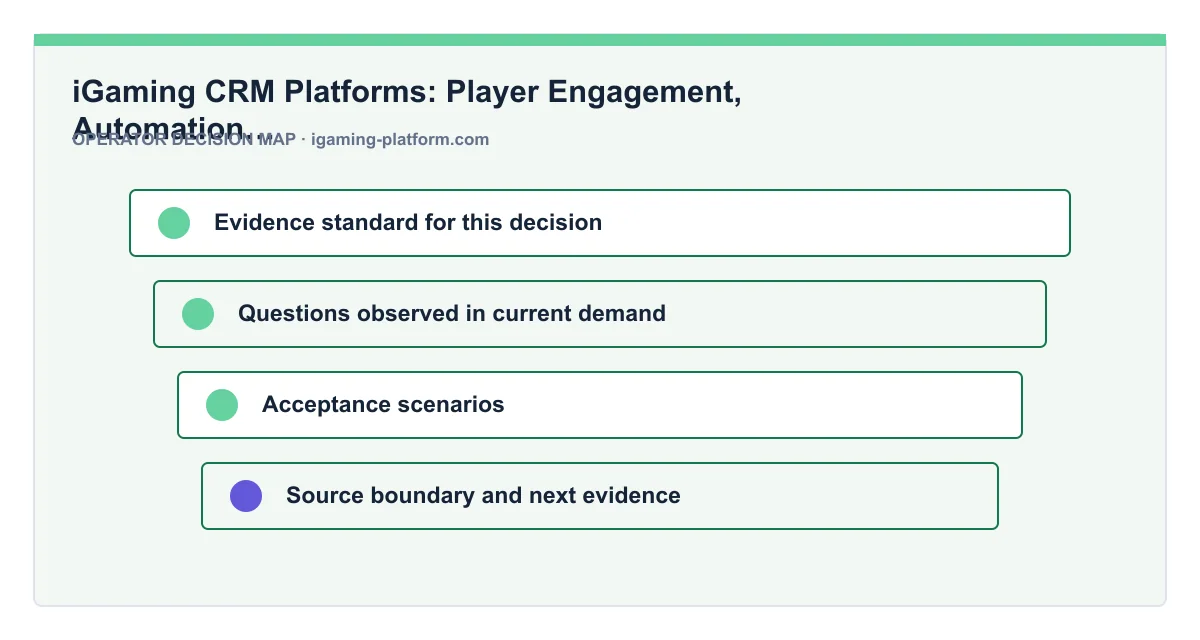
Research-backed decision brief - checked 2026-07-24
iGaming CRM Platforms: Player Engagement, Automation & Retention Comparison: the decision-ready answer
Start with the system boundary and data flow, then verify interfaces, identity, versioning, latency, capacity, failure handling, reconciliation, observability, recovery, and ownership. A component name or architecture diagram is not implementation evidence.
The assigned US English query igaming platform architecture was checked on July 24, 2026. The result pattern was used to validate the page intent and question set.
Evidence standard for this decision
Use Yes only when a current source or test explicitly supports the field; Partial when it supports only part of the scope; Not found when the reviewed public sources do not expose it; and Unknown when it has not yet been evaluated. Not found is not evidence that a capability is absent.
| Decision field | Evidence to request | Pass signal | Keep unresolved when |
|---|---|---|---|
| Boundary and data | Component, trust-boundary, event, and system-of-record map | Source, destination, owner, retention, and reconciliation are explicit | The diagram omits failure and ownership |
| Interface contract | Versioned schema, auth, limits, idempotency, errors, and deprecation | Consumer tests run against a representative sandbox | Only endpoint names or an integration claim are public |
| Reliability | SLOs, dependency budgets, capacity tests, recovery objectives, and drills | Targets have a measurement source and failure response | Scalable or highly available is the only claim |
| Security and operations | Access, audit, secrets, vulnerability, change, incident, and export evidence | Controls are testable and owned across parties | A certificate replaces workflow evidence |
Questions observed in current demand
The questions below combine the assigned search intent with the evidence gaps found in the current page review.
Where does iGaming CRM Platforms: Player Engagement, Automation & Retention Comparison sit in the end-to-end architecture and data flow?
Start with the system boundary and data flow, then verify interfaces, identity, versioning, latency, capacity, failure handling, reconciliation, observability, recovery, and ownership. A component name or architecture diagram is not implementation evidence. Apply that evidence rule specifically to iGaming CRM Platforms: Player Engagement, Automation & Retention Comparison and keep unverified product, price, market, and performance claims marked as unknown.
Question source: archetype - technical / architecture
Which APIs, events, files, authentication methods, versions, and ownership boundaries are required?
Start with the system boundary and data flow, then verify interfaces, identity, versioning, latency, capacity, failure handling, reconciliation, observability, recovery, and ownership. A component name or architecture diagram is not implementation evidence. Apply that evidence rule specifically to iGaming CRM Platforms: Player Engagement, Automation & Retention Comparison and keep unverified product, price, market, and performance claims marked as unknown.
Question source: archetype - technical / architecture
What latency, throughput, availability, recovery, and capacity targets are testable?
Translate the claim into a target, measurement source, time window, exclusions, dependency boundary, recovery objective, failure test, and contractual response.
Question source: archetype - technical / architecture
Acceptance scenarios
- Replay duplicate, delayed, out-of-order, and partially failed requests and reconcile the final state.
- Load-test the peak business event with the same dependency limits and observability used in production.
- Revoke a privileged user, rotate a secret, restore a service, and export the resulting audit record.
Source boundary and next evidence
The linked study is the direct research source for this page's topic cluster. It publishes the sample or control set, field definitions, classifications, checked date, primary-source ledger, limitations, and downloadable data. It does not replace jurisdiction-specific legal advice, a supplier proposal, authenticated documentation, a production test, customer references, or a signed contract.
Read the platform architecture research study or download its CSV dataset.
CRM platforms play a central role in how iGaming operators manage player relationships, optimize lifetime value, and comply with responsible gambling requirements. Unlike generic CRM systems, iGaming CRM platforms operate in real time, interact directly with wallets and gameplay data, and influence financial outcomes through bonuses, personalization, and behavioral automation.
This page provides a side-by-side comparison of iGaming CRM platforms, focusing on bonus management, player segmentation, automation workflows, A/B testing capabilities, and long-term retention mechanics.
The Role of CRM in iGaming Platforms
In iGaming, CRM systems function as operational control layers rather than simple marketing tools. They aggregate player activity across games, payments, and accounts, enabling operators to react to behavior in near real time.
Modern iGaming CRMs are tightly integrated with PAM, wallets, and game providers. This allows them to trigger bonuses, messages, or restrictions based on granular player actions, such as wagering patterns, session frequency, or deposit behavior. As a result, CRM architecture directly affects both revenue optimization and regulatory compliance.

I’m an iGaming copywriter specializing in high-conversion storytelling for online casinos, sportsbooks, and gaming platforms. I translate complex products, mechanics, and offers into clear, engaging copy that resonates with players while aligning with brand voice and regulatory requirements.
Bonus Management & Player Incentives
Bonus systems are among the most complex components of iGaming CRM platforms. They must balance promotional effectiveness with regulatory constraints and financial risk.
Common bonus capabilities supported by iGaming CRMs include:
- Multi-stage bonus campaigns with wagering requirements
- Free spins, cashback, and personalized offers
- Jurisdiction-specific bonus rules and limits
- Real-time bonus activation and cancellation
The depth of bonus configuration and the transparency of bonus logic are critical factors when evaluating CRM platforms, particularly in regulated markets.
Segmentation, Automation & Behavioral Logic
Effective player retention depends on accurate segmentation and automated response to player behavior. iGaming CRM platforms typically segment players based on activity, value, risk profile, and lifecycle stage.
Automation engines then use these segments to trigger communications, bonuses, or restrictions without manual intervention. More advanced platforms support dynamic segmentation that updates in real time as player behavior changes, allowing operators to react immediately rather than relying on static campaigns.
A/B Testing & Optimization Capabilities
A/B testing has become a core requirement for data-driven iGaming operations. CRM platforms increasingly include native experimentation tools that allow operators to test bonus mechanics, messaging timing, and engagement strategies.
These tools enable controlled experimentation without external analytics platforms, reducing operational complexity and improving decision-making speed. However, not all CRM systems offer statistically robust testing frameworks, making evaluation of experimentation depth an important consideration.
iGaming CRM Platforms Compared
| Capability Area | Advanced iGaming CRM Platforms | Basic CRM Systems |
|---|---|---|
| Player Segmentation | Real-time, behavior-based | Static, rule-based |
| Bonus Management | Complex, configurable | Limited |
| Automation | Event-driven workflows | Manual or scheduled |
| A/B Testing | Native experimentation | External tools required |
| Retention Focus | Lifecycle optimization | Campaign-centric |
This comparison highlights how CRM maturity impacts both revenue potential and operational control.
Methodology & Evaluation Criteria
This comparison evaluates iGaming CRM platforms based on their ability to support sustained player engagement under regulatory constraints.
Platforms are assessed using the following criteria:
- Depth and flexibility of player segmentation
- Bonus configuration and enforcement logic
- Automation capabilities and real-time responsiveness
- Native A/B testing and optimization features
- Integration with PAM, payments, and game providers
The objective is to identify CRM architectures that support long-term retention without increasing operational or compliance risk.
CRM Architecture Trends in iGaming
Modern iGaming CRM platforms are evolving toward real-time data processing, tighter integration with core backend systems, and increased automation of compliance-related actions. There is also a growing emphasis on explainability, ensuring that bonus logic and segmentation decisions can be audited and justified to regulators.
These trends reflect increasing scrutiny of player treatment and the need for CRM systems to function as both engagement and control mechanisms.
Frequently Asked Questions (FAQ)
What makes an iGaming CRM different from a standard CRM?
iGaming CRMs operate in real time and integrate directly with gameplay, wallets, and compliance systems, rather than focusing only on marketing communications.
Are bonuses always managed through CRM platforms?
In most modern platforms, yes. Bonus logic is typically centralized within the CRM to ensure consistency and regulatory control.
How important is A/B testing in iGaming CRM?
A/B testing is critical for optimizing bonuses and messaging while minimizing financial and regulatory risk.
Can CRM platforms support responsible gambling requirements?
Yes. Many CRM systems enforce limits, trigger interventions, and support player protection workflows.
Does CRM complexity increase operational risk?
It can if poorly implemented. Well-designed CRM platforms reduce risk by automating decisions and enforcing consistent rules across the player lifecycle.
Concept map
Related concepts and decision guides
- iGaming Software Modules
- Evaluate platform modules separately while preserving end-to-end workflow, data, and operational ownership.
- iGaming PAM Platforms: Core Backend Architecture & Capability Comparison
- Player Account Management (PAM) systems form the operational core of any iGaming platform.
- iGaming platform API
- API-first architecture has become a defining characteristic of modern iGaming platforms.
- player wallet
- Assess ledger integrity, multi-currency, rollback, reconciliation, and wallet APIs.
- iGaming Reporting and BI technical guide
- Evaluate operational reporting, semantic definitions, exports, and data latency.
Evidence layer
Primary references and verification limits
Sources were checked on . They support the standards and verification questions used in this guide. They do not prove a supplier-specific price, market eligibility, implementation result, or private product claim; buyers should request current, versioned evidence for those points.
- iGaming Platform - platform architecture research 2026 Original publisher research. A dated methodology, evidence matrix, primary-source ledger, limitations, and downloadable CSV supporting this page's decision framework.
- OWASP Application Security Verification Standard Open application-security standard. Testable web-application security requirements and procurement-ready verification criteria.
- NIST Cybersecurity Framework 2.0 Government standards body. Cybersecurity governance, risk management, protection, detection, response, and recovery outcomes.
- AWS Well-Architected — Reliability Pillar Cloud architecture guidance. Availability targets, resilience testing, incident learning, recovery objectives, capacity, and dependency management.
- UK Gambling Commission — Remote gambling and software technical standards Regulator. Remote gambling software controls, security requirements, player-facing technical controls, and jurisdiction-specific verification questions.
- UK Gambling Commission — Testing strategy for remote gambling software Regulator. Testing, release control, audit evidence, change management, independent review, and production assurance questions.