
 Kody Nexov
 Published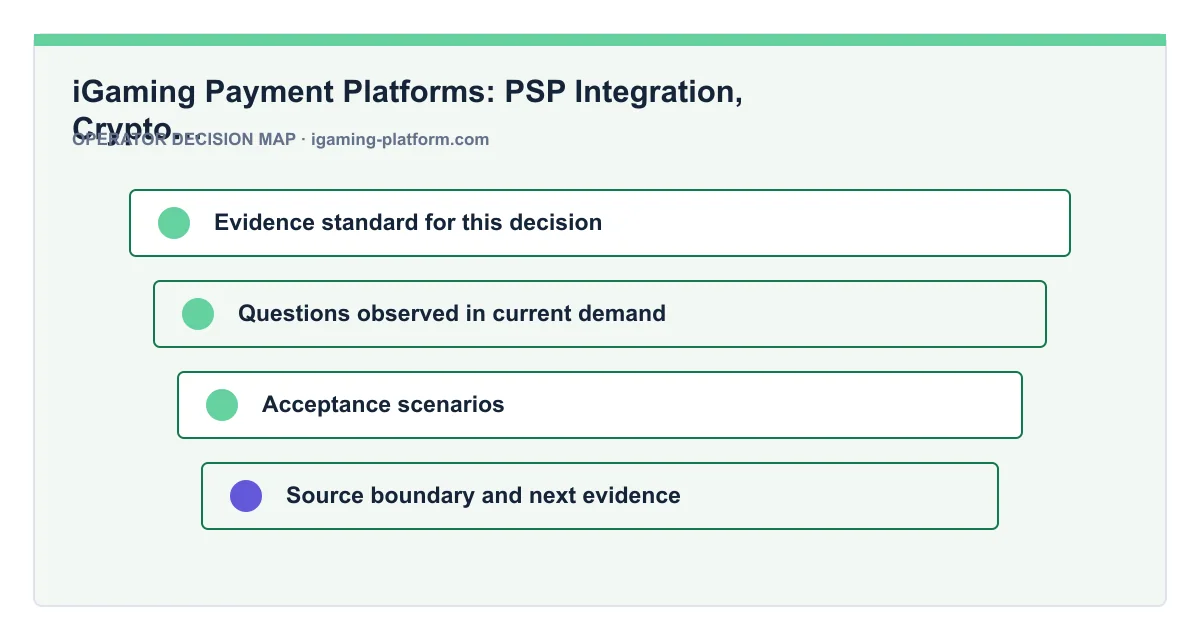
Research-backed decision brief - checked 2026-07-24
iGaming Payment Platforms: PSP Integration, Crypto Support & Compliance Comparison: the decision-ready answer
The correct control set depends on the licensed entity, jurisdiction, product, payment flow, data role, and operating model. Map authoritative obligations to named owners, configurable controls, logs, case evidence, tests, exceptions, and escalation paths.
The assigned US English query crypto casino software was checked on July 24, 2026. The result included People also ask, so concise answer structure and explicit source boundaries matter for both search and answer engines.
Evidence standard for this decision
Use Yes only when a current source or test explicitly supports the field; Partial when it supports only part of the scope; Not found when the reviewed public sources do not expose it; and Unknown when it has not yet been evaluated. Not found is not evidence that a capability is absent.
| Decision field | Evidence to request | Pass signal | Keep unresolved when |
|---|---|---|---|
| Applicable rule | Current regulator, law, or versioned standard | Scope and effective date are explicit | A supplier badge substitutes for applicability analysis |
| Responsibility | RACI across operator, platform, supplier, and sub-processors | Every decision and evidence artifact has an accountable owner | The contract says both parties cooperate |
| Operating control | Configuration, thresholds, overrides, cases, logs, and retention | A reviewer can reproduce why an action occurred | Only a policy document is supplied |
| Assurance | Test cases, samples, exceptions, remediation, and re-test | Failures have an owner and closure evidence | Certification is treated as proof of every local control |
Questions observed in current demand
The questions below combine the assigned search intent with the evidence gaps found in the current page review.
Which obligations relevant to iGaming Payment Platforms: PSP Integration, Crypto Support & Compliance Comparison change by jurisdiction, licence, entity, and operating model?
Start with the applicable entity, market, product, and operating model; then map the authoritative requirement to an owner, configurable control, case record, log, test, exception, and escalation path.
Question source: archetype - compliance / risk
Which party is responsible, accountable, consulted, and informed for each control?
Start with the applicable entity, market, product, and operating model; then map the authoritative requirement to an owner, configurable control, case record, log, test, exception, and escalation path.
Question source: archetype - compliance / risk
What policy, system, log, test, and case evidence demonstrates that each control operates?
Start with the applicable entity, market, product, and operating model; then map the authoritative requirement to an owner, configurable control, case record, log, test, exception, and escalation path.
Question source: archetype - compliance / risk
Acceptance scenarios
- Trace one normal, one high-risk, and one exception case from input through decision, review, and retained evidence.
- Change a market rule or threshold and verify approval, deployment, monitoring, rollback, and audit history.
- Simulate a regulator or auditor evidence request and measure whether the complete record can be exported.
Source boundary and next evidence
The linked study is the direct research source for this page's topic cluster. It publishes the sample or control set, field definitions, classifications, checked date, primary-source ledger, limitations, and downloadable data. It does not replace jurisdiction-specific legal advice, a supplier proposal, authenticated documentation, a production test, customer references, or a signed contract.
Read the platform architecture research study or download its CSV dataset.
Payment infrastructure is a critical dependency in iGaming platforms, directly affecting user conversion, operational risk, and regulatory exposure. Unlike front-end features, payment architecture influences onboarding speed, transaction reliability, and the platform’s ability to operate across multiple jurisdictions.
This page provides a technical comparison of iGaming payment platforms, focusing on PSP integrations, crypto-friendly solutions, onboarding workflows, and compliance considerations from an operator-focused perspective.
The Role of Payment Platforms in iGaming Operations
iGaming payment platforms act as an orchestration layer between players, financial institutions, and regulatory systems. They are responsible not only for processing deposits and withdrawals, but also for enforcing transaction-level controls, currency handling, and reconciliation across providers.
Modern payment platforms are increasingly modular, enabling operators to connect multiple PSPs, local payment methods, and alternative currencies through a unified integration layer. This reduces dependency on single providers and improves resilience in markets where payment availability can change rapidly.

I’m an iGaming copywriter specializing in high-conversion storytelling for online casinos, sportsbooks, and gaming platforms. I translate complex products, mechanics, and offers into clear, engaging copy that resonates with players while aligning with brand voice and regulatory requirements.
PSP Integrations & Supported Payment Methods
The breadth and quality of PSP integrations determine how effectively a platform can support regional markets. Payment platforms typically integrate a mix of global PSPs, local acquiring banks, and alternative payment methods tailored to specific jurisdictions.
Commonly supported methods include card payments, bank transfers, e-wallets, instant local payment systems, and cryptocurrencies. Platforms with flexible routing logic can dynamically select providers based on geography, transaction size, or risk profile, improving acceptance rates and reducing payment friction.
Crypto-Friendly Payment Architecture
Cryptocurrency support has become a differentiating factor for many iGaming platforms, particularly in markets with limited traditional banking access or higher transaction restrictions.
Crypto-friendly payment platforms typically support on-chain deposits and withdrawals, multi-currency wallets, and integration with blockchain monitoring tools. While crypto can reduce dependency on traditional PSPs, it introduces additional compliance and risk management requirements, particularly around transaction monitoring and fund provenance.
As a result, crypto support is increasingly implemented as an optional payment layer rather than a core replacement for fiat infrastructure.
Onboarding Speed & Operational Efficiency
Payment onboarding speed affects both player acquisition and operator launch timelines. Platforms that rely on standardized PSP integrations and reusable compliance workflows can significantly reduce time to market.
Faster onboarding is typically enabled by centralized configuration, pre-certified payment connectors, and automated compliance checks. However, rapid onboarding must be balanced against regulatory obligations, as insufficient verification or transaction controls can increase exposure to chargebacks and compliance violations.
iGaming Payment Platforms Compared
| Evaluation Area | Modern Payment Platforms | Legacy Payment Setups |
|---|---|---|
| PSP Integration Model | Unified orchestration layer | Direct, provider-specific |
| Supported Methods | Global + local + crypto | Limited, market-specific |
| Onboarding Speed | Fast, reusable integrations | Slow, manual setup |
| Compliance Controls | Integrated, configurable | Fragmented |
| Operational Resilience | High | Low to medium |
This comparison illustrates how payment architecture impacts both scalability and regulatory alignment.
Methodology & Evaluation Criteria
This analysis evaluates iGaming payment platforms based on operational and compliance-driven criteria rather than transaction fees or commercial terms.
Platforms are assessed using the following criteria:
- Breadth and reliability of PSP integrations
- Support for local and alternative payment methods
- Crypto transaction handling and monitoring capabilities
- Onboarding speed for new markets and providers
- Embedded compliance and risk controls
The objective is to highlight payment architectures that support long-term operational stability and regulatory adaptability.
Compliance Considerations & Risk Management
Payment platforms play a central role in AML enforcement, transaction monitoring, and audit readiness. Regulatory requirements often mandate strict controls around transaction limits, identity verification, and suspicious activity reporting.
Platforms with centralized payment logic and detailed transaction logging are better positioned to respond to regulatory audits and evolving compliance standards. Fragmented payment setups, by contrast, increase operational risk and reporting complexity.
Frequently Asked Questions (FAQ)
What is an iGaming payment platform?
It is a system that manages deposits, withdrawals, and payment provider integrations while enforcing transaction-level controls and compliance requirements.
How important are local payment methods in iGaming?
Local methods significantly impact conversion rates and market accessibility, especially in regulated or emerging markets.
Does crypto support reduce reliance on traditional PSPs?
Partially. Crypto can complement traditional payments but rarely replaces them entirely due to compliance and volatility considerations.
Can payment architecture affect licensing approval?
Yes. Regulators often assess payment flows, transaction controls, and audit capabilities as part of the licensing process.
Are unified payment platforms better than direct PSP integrations?
Unified platforms simplify operations and compliance but may introduce additional abstraction layers. The suitability depends on operator scale and complexity.
Concept map
Related concepts and decision guides
- iGaming Software Modules guide
- Evaluate platform modules separately while preserving end-to-end workflow, data, and operational ownership.
- KYC and AML Platform Module
- Map verification, monitoring, case management, and reporting into the platform.
- iGaming platform architecture
- The architecture of an iGaming platform defines far more than infrastructure choices.
- iGaming platform API
- API-first architecture has become a defining characteristic of modern iGaming platforms.
- PAM iGaming platform
- Player Account Management (PAM) systems form the operational core of any iGaming platform.
Evidence layer
Primary references and verification limits
Sources were checked on . They support the standards and verification questions used in this guide. They do not prove a supplier-specific price, market eligibility, implementation result, or private product claim; buyers should request current, versioned evidence for those points.
- iGaming Platform - platform architecture research 2026 Original publisher research. A dated methodology, evidence matrix, primary-source ledger, limitations, and downloadable CSV supporting this page's decision framework.
- FATF Recommendations Intergovernmental standard setter. Risk-based AML/CFT controls, customer due diligence, monitoring, recordkeeping, and country-specific implementation questions.
- PCI Security Standards Council — PCI DSS Industry standards body. Payment account data security requirements for merchants, processors, service providers, and systems that can affect the cardholder data environment.
- OWASP Application Security Verification Standard Open application-security standard. Testable web-application security requirements and procurement-ready verification criteria.
- NIST Cybersecurity Framework 2.0 Government standards body. Cybersecurity governance, risk management, protection, detection, response, and recovery outcomes.
- AWS Well-Architected — Reliability Pillar Cloud architecture guidance. Availability targets, resilience testing, incident learning, recovery objectives, capacity, and dependency management.
- UK Gambling Commission — Remote gambling and software technical standards Regulator. Remote gambling software controls, security requirements, player-facing technical controls, and jurisdiction-specific verification questions.
- UK Gambling Commission — Testing strategy for remote gambling software Regulator. Testing, release control, audit evidence, change management, independent review, and production assurance questions.