
 Kody Nexov
 Published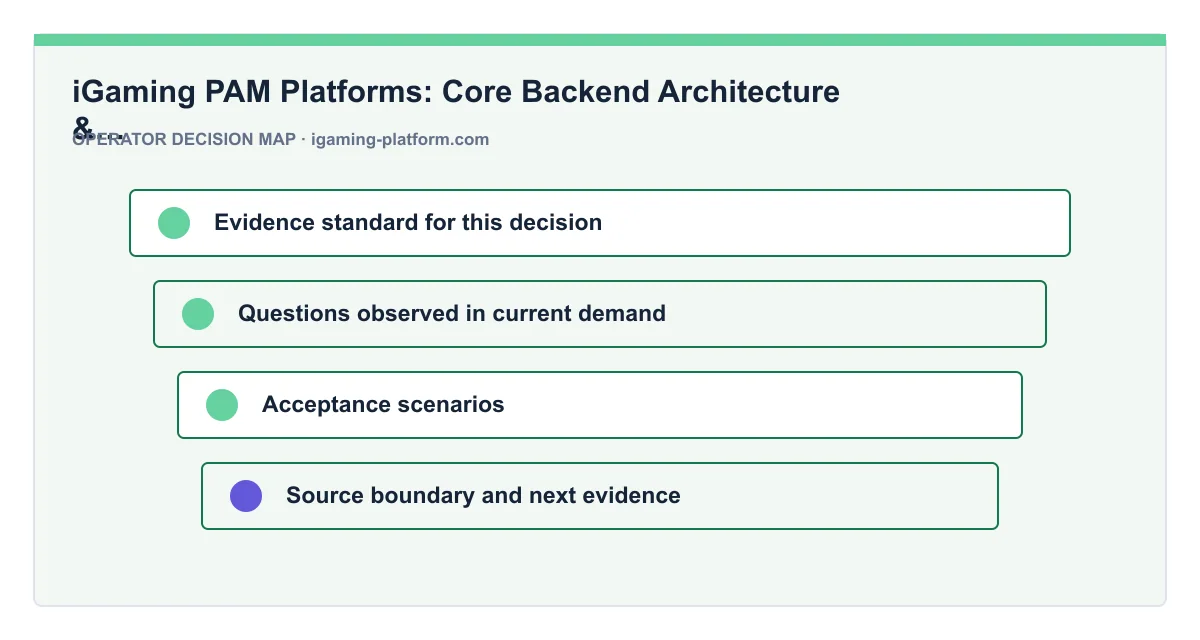
Research-backed decision brief - checked 2026-07-24
iGaming PAM Platforms: Core Backend Architecture & Capability Comparison: the decision-ready answer
Start with the system boundary and data flow, then verify interfaces, identity, versioning, latency, capacity, failure handling, reconciliation, observability, recovery, and ownership. A component name or architecture diagram is not implementation evidence.
The assigned US English query igaming PAM platform was checked on July 24, 2026. The result included People also ask, so concise answer structure and explicit source boundaries matter for both search and answer engines.
Evidence standard for this decision
Use Yes only when a current source or test explicitly supports the field; Partial when it supports only part of the scope; Not found when the reviewed public sources do not expose it; and Unknown when it has not yet been evaluated. Not found is not evidence that a capability is absent.
| Decision field | Evidence to request | Pass signal | Keep unresolved when |
|---|---|---|---|
| Boundary and data | Component, trust-boundary, event, and system-of-record map | Source, destination, owner, retention, and reconciliation are explicit | The diagram omits failure and ownership |
| Interface contract | Versioned schema, auth, limits, idempotency, errors, and deprecation | Consumer tests run against a representative sandbox | Only endpoint names or an integration claim are public |
| Reliability | SLOs, dependency budgets, capacity tests, recovery objectives, and drills | Targets have a measurement source and failure response | Scalable or highly available is the only claim |
| Security and operations | Access, audit, secrets, vulnerability, change, incident, and export evidence | Controls are testable and owned across parties | A certificate replaces workflow evidence |
Questions observed in current demand
The questions below combine the assigned search intent with the evidence gaps found in the current page review.
Where does iGaming PAM Platforms: Core Backend Architecture & Capability Comparison sit in the end-to-end architecture and data flow?
Start with the system boundary and data flow, then verify interfaces, identity, versioning, latency, capacity, failure handling, reconciliation, observability, recovery, and ownership. A component name or architecture diagram is not implementation evidence. Apply that evidence rule specifically to iGaming PAM Platforms: Core Backend Architecture & Capability Comparison and keep unverified product, price, market, and performance claims marked as unknown.
Question source: archetype - technical / architecture
Which APIs, events, files, authentication methods, versions, and ownership boundaries are required?
Start with the system boundary and data flow, then verify interfaces, identity, versioning, latency, capacity, failure handling, reconciliation, observability, recovery, and ownership. A component name or architecture diagram is not implementation evidence. Apply that evidence rule specifically to iGaming PAM Platforms: Core Backend Architecture & Capability Comparison and keep unverified product, price, market, and performance claims marked as unknown.
Question source: archetype - technical / architecture
What latency, throughput, availability, recovery, and capacity targets are testable?
Translate the claim into a target, measurement source, time window, exclusions, dependency boundary, recovery objective, failure test, and contractual response.
Question source: archetype - technical / architecture
Acceptance scenarios
- Replay duplicate, delayed, out-of-order, and partially failed requests and reconcile the final state.
- Load-test the peak business event with the same dependency limits and observability used in production.
- Revoke a privileged user, rotate a secret, restore a service, and export the resulting audit record.
Source boundary and next evidence
The linked study is the direct research source for this page's topic cluster. It publishes the sample or control set, field definitions, classifications, checked date, primary-source ledger, limitations, and downloadable data. It does not replace jurisdiction-specific legal advice, a supplier proposal, authenticated documentation, a production test, customer references, or a signed contract.
Read the platform architecture research study or download its CSV dataset.
Player Account Management (PAM) systems form the operational core of any iGaming platform. PAM is responsible for player identity, account state, wallets, permissions, and transactional consistency across all games and services. The design and capabilities of the PAM layer directly influence platform stability, regulatory compliance, and scalability under real-money conditions.
This page provides a technical comparison of iGaming PAM platforms, focusing on account management models, risk and control mechanisms, scalability constraints, and core backend responsibilities.
The Role of PAM in iGaming Platform Architecture
PAM systems act as the authoritative source of truth for player data and transactional state. Every login, balance update, bet placement, bonus allocation, and withdrawal request ultimately depends on PAM logic.
In modern iGaming environments, PAM is no longer a monolithic module. It is increasingly designed as a service-oriented layer that interacts with wallets, game servers, payment providers, CRM systems, and compliance tools. This makes PAM architecture a central factor in both operational resilience and regulatory transparency.

I’m an iGaming copywriter specializing in high-conversion storytelling for online casinos, sportsbooks, and gaming platforms. I translate complex products, mechanics, and offers into clear, engaging copy that resonates with players while aligning with brand voice and regulatory requirements.
Core Account Management Capabilities
At a functional level, PAM platforms are responsible for managing player lifecycle states and enforcing consistent account behavior across all integrated services.
Typical PAM responsibilities include player registration, authentication, account status management, wallet balance handling, and permission enforcement. These functions must remain consistent across multiple game providers, currencies, and jurisdictions, often under high transaction volume and real-time constraints.
Failures or inconsistencies at the PAM level can propagate across the entire platform, making reliability and transactional integrity critical evaluation criteria.
Risk Controls & Regulatory Enforcement
Risk management and compliance enforcement are tightly coupled with PAM functionality. Regulatory requirements often mandate that player-level controls be implemented directly within the account management layer rather than as external services.
Common risk and control mechanisms supported by PAM platforms include:
- Player verification and identity status tracking
- Deposit, loss, and wagering limits
- Self-exclusion and responsible gambling controls
- Transaction monitoring and audit logging
The depth and configurability of these controls vary significantly between platforms and often determine how easily operators can adapt to new regulatory environments.
PAM Platform Scalability & Performance Constraints
Scalability at the PAM level is fundamentally different from front-end or content scalability. PAM systems must process high-frequency state changes with strong consistency guarantees, especially during peak traffic events.
Key scalability challenges include concurrent balance updates, session management across distributed services, and transactional synchronization with external systems. Platforms that rely on tightly coupled or state-heavy PAM implementations may encounter bottlenecks as user volume or game complexity increases.
As a result, modern PAM platforms increasingly adopt distributed processing models and stateless service patterns where possible, while preserving transactional accuracy.
PAM Platforms Compared: Core Capabilities
| Capability Area | Modern PAM Platforms | Legacy PAM Systems |
|---|---|---|
| Account State Management | Centralized, service-oriented | Monolithic |
| Wallet & Balance Logic | Real-time, multi-currency | Limited flexibility |
| Risk & Limit Controls | Configurable, jurisdiction-based | Hard-coded |
| Scalability Model | Horizontal scaling | Vertical scaling |
| Integration Flexibility | API-driven | Restricted |
This comparison highlights how architectural choices influence both operational flexibility and long-term scalability.
Methodology & Evaluation Criteria
This comparison evaluates PAM platforms from a backend and regulatory perspective rather than a marketing or feature checklist viewpoint.
Platforms are assessed using the following criteria:
- Transactional consistency and state integrity
- Support for jurisdiction-specific account controls
- Scalability under concurrent real-money operations
- Integration with external services and providers
- Operational impact of maintaining account-level logic
The goal is to identify PAM architectures that support sustainable growth while minimizing regulatory and operational risk.
Architectural Trends in PAM Systems
PAM platforms are evolving toward modular service layers, improved event logging, and tighter integration with compliance tooling. There is also a growing emphasis on real-time monitoring and automated enforcement of player-level rules.
These trends reflect increasing regulatory scrutiny and the need for PAM systems to function as both operational engines and compliance control points.
Frequently Asked Questions (FAQ)
What is a PAM platform in iGaming?
A PAM platform manages player accounts, balances, permissions, and transactional state across an iGaming system.
Is PAM separate from wallet and payment systems?
PAM often includes wallet logic but integrates with external payment providers. The degree of separation depends on platform architecture.
How does PAM affect regulatory compliance?
PAM enforces player-level controls such as limits, verification status, and exclusions, making it central to regulatory compliance.
Can PAM scalability limit platform growth?
Yes. PAM bottlenecks can restrict user concurrency and transaction throughput, even if other platform components scale effectively.
Are modern PAM platforms API-driven?
Most modern PAM systems expose APIs for integration with games, payments, and CRM, though implementation depth varies by provider.
Concept map
Related concepts and decision guides
- iGaming Software Modules guide
- Evaluate platform modules separately while preserving end-to-end workflow, data, and operational ownership.
- iGaming CRM platform
- CRM platforms play a central role in how iGaming operators manage player relationships, optimize lifetime value, and comply with responsible gambling requirements.
- iGaming platform API
- API-first architecture has become a defining characteristic of modern iGaming platforms.
- iGaming platform architecture
- The architecture of an iGaming platform defines far more than infrastructure choices.
- Game Aggregator API technical guide
- Assess game catalogue, launch flows, wallet calls, events, and certification boundaries.
Evidence layer
Primary references and verification limits
Sources were checked on . They support the standards and verification questions used in this guide. They do not prove a supplier-specific price, market eligibility, implementation result, or private product claim; buyers should request current, versioned evidence for those points.
- iGaming Platform - platform architecture research 2026 Original publisher research. A dated methodology, evidence matrix, primary-source ledger, limitations, and downloadable CSV supporting this page's decision framework.
- OWASP Application Security Verification Standard Open application-security standard. Testable web-application security requirements and procurement-ready verification criteria.
- NIST Cybersecurity Framework 2.0 Government standards body. Cybersecurity governance, risk management, protection, detection, response, and recovery outcomes.
- AWS Well-Architected — Reliability Pillar Cloud architecture guidance. Availability targets, resilience testing, incident learning, recovery objectives, capacity, and dependency management.
- UK Gambling Commission — Remote gambling and software technical standards Regulator. Remote gambling software controls, security requirements, player-facing technical controls, and jurisdiction-specific verification questions.
- UK Gambling Commission — Testing strategy for remote gambling software Regulator. Testing, release control, audit evidence, change management, independent review, and production assurance questions.