
 Kody Nexov
 Published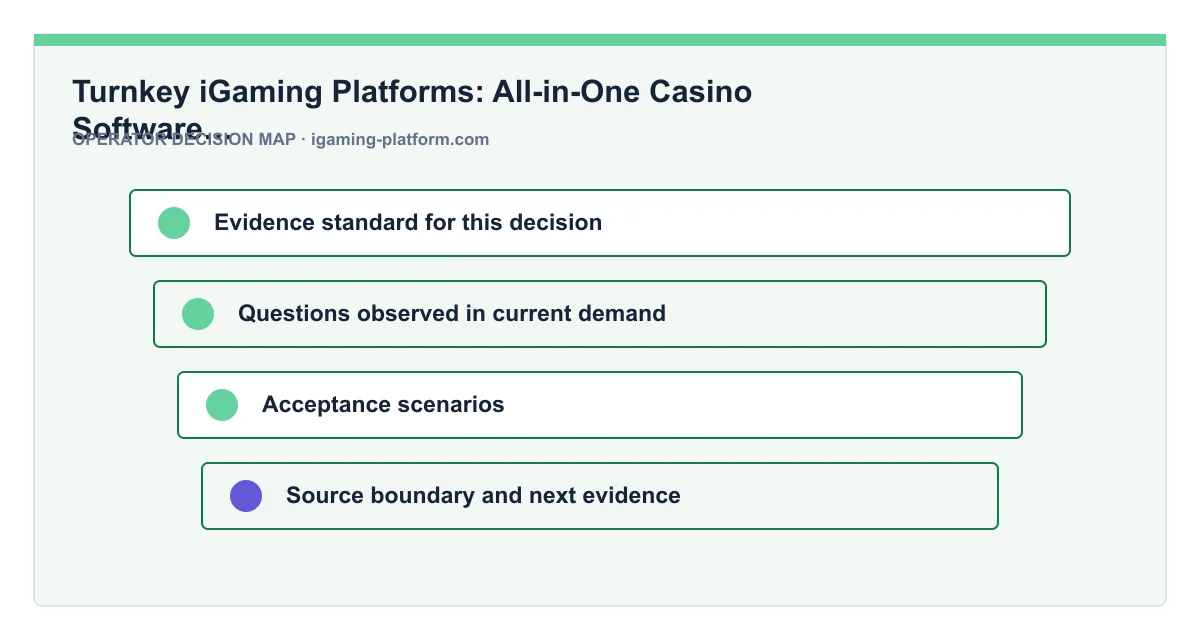
Research-backed decision brief - checked 2026-07-24
Turnkey iGaming Platforms: All-in-One Casino Software Comparison: the decision-ready answer
There is no universal best option. Freeze the operator profile, jurisdiction, product boundary, delivery model, retained team, timeline, and risk tolerance; compare like-for-like evidence; and keep public unknowns unresolved until an RFP, demo, test, reference, or contract closes them.
The assigned US English query turnkey igaming platform was checked on July 24, 2026. The result included People also ask, so concise answer structure and explicit source boundaries matter for both search and answer engines.
Evidence standard for this decision
Use Yes only when a current source or test explicitly supports the field; Partial when it supports only part of the scope; Not found when the reviewed public sources do not expose it; and Unknown when it has not yet been evaluated. Not found is not evidence that a capability is absent.
| Decision field | Evidence to request | Pass signal | Keep unresolved when |
|---|---|---|---|
| Comparison set | One buyer profile and explicit inclusion and exclusion rules | Candidates solve the same layer and operating problem | Platforms, modules, services, and content are mixed |
| Capability evidence | Current official documentation and buyer-owned workflow tests | Yes, Partial, Not found, and Unknown remain distinct | Feature count replaces evidence quality |
| Delivery fit | Responsibility, integration, staffing, market, and implementation map | Retained duties and dependencies are affordable and owned | Turnkey is interpreted as no operator work |
| Commercial and exit | Normalized TCO, SLA, data rights, transition, and remedies | The shortlist remains viable under a high case and an exit case | Only headline price and launch speed are compared |
Questions observed in current demand
The questions below combine the assigned search intent with the evidence gaps found in the current page review.
Which solution types actually solve the buyer need covered by Turnkey iGaming Platforms: All-in-One Casino Software Comparison?
There is no universal best option. Freeze the operator profile, jurisdiction, product boundary, delivery model, retained team, timeline, and risk tolerance; compare like-for-like evidence; and keep public unknowns unresolved until an RFP, demo, test, reference, or contract closes them. Apply that evidence rule specifically to Turnkey iGaming Platforms: All-in-One Casino Software Comparison and keep unverified product, price, market, and performance claims marked as unknown.
Question source: archetype - comparison / category
Which candidates belong in the same comparison set, and which solve a different layer?
There is no universal best option. Freeze the operator profile, jurisdiction, product boundary, delivery model, retained team, timeline, and risk tolerance; compare like-for-like evidence; and keep public unknowns unresolved until an RFP, demo, test, reference, or contract closes them. Apply that evidence rule specifically to Turnkey iGaming Platforms: All-in-One Casino Software Comparison and keep unverified product, price, market, and performance claims marked as unknown.
Question source: archetype - comparison / category
Which operator profile, market, product scope, and delivery model changes the shortlist?
Answer it for a defined operator profile. Compare only like-for-like options, apply one evidence rule, and leave supplier-specific unknowns open until they are closed by current documentation, testing, references, or contract terms.
Question source: archetype - comparison / category
Acceptance scenarios
- Score every candidate against the same evidence rule and preserve Not found instead of converting it to No.
- Run the same critical workflow and failure case in each shortlisted product or environment.
- Compare the base, high-volume, delayed-launch, and exit scenario before ranking suppliers.
Source boundary and next evidence
The linked study is the direct research source for this page's topic cluster. It publishes the sample or control set, field definitions, classifications, checked date, primary-source ledger, limitations, and downloadable data. It does not replace jurisdiction-specific legal advice, a supplier proposal, authenticated documentation, a production test, customer references, or a signed contract.
Read the platform architecture research study or download its CSV dataset.
Turnkey iGaming platforms are built for operators who want to launch quickly using a pre-assembled, operationally ready software stack. These “all-in-one” solutions typically bundle core backend components such as player account management, wallet, game aggregation, basic CRM, reporting, and integrations with common third-party services. The value proposition is speed and simplicity. The trade-off is reduced flexibility compared to fully custom builds and, in some cases, higher long-term dependency on vendor constraints.
This page provides a comparison of turnkey iGaming platforms and all-in-one casino software solutions, focusing on feature scope, pricing logic, scalability implications, and which operator profiles each model fits best.
What Turnkey iGaming Platforms Typically Include
A turnkey platform usually offers a packaged stack designed to cover the minimum set of systems required to operate an online casino or sportsbook brand. While exact scope varies by provider, turnkey platforms often include core modules for player accounts, wallet transactions, game content delivery, reporting dashboards, and standard compliance controls.
Operators typically configure branding, payment methods, and content selection rather than engineering the underlying logic. As a result, turnkey platforms often reduce the need for a large internal technical team at launch, especially when the target markets align with the platform’s existing integrations.

I’m an iGaming copywriter specializing in high-conversion storytelling for online casinos, sportsbooks, and gaming platforms. I translate complex products, mechanics, and offers into clear, engaging copy that resonates with players while aligning with brand voice and regulatory requirements.
Feature Scope: What Matters Beyond the Checklist
Feature lists can look similar across turnkey providers, but operational impact depends on how features behave in real-world conditions. In iGaming, the difference between “available” and “usable at scale” is often determined by integration depth, automation, and flexibility.
Two areas tend to separate strong turnkey platforms from basic stacks: how effectively the platform manages multi-provider operations (payments, content, and compliance) and how configurable the system is without requiring custom development. The ability to control bonus logic, player-level rules, and payment routing often determines whether a turnkey solution can support growth beyond an initial launch phase.
Pricing Logic & Commercial Structures
Turnkey pricing is rarely a simple monthly fee. Commercial structures commonly combine a setup cost with recurring platform fees, plus variable components tied to volume, modules, or integrations.
When evaluating pricing logic, operators should focus on how costs scale with growth. Some platforms offer predictable fixed pricing but charge extra for integrations, advanced modules, or jurisdiction-specific compliance support. Others reduce upfront cost but include revenue-linked components such as revenue share, minimum monthly commitments, or transaction-based fees.
A practical evaluation point is whether the platform becomes cheaper per unit of revenue as the operation scales, or whether variable fees expand in a way that compresses margins at higher volume.
Scalability: Operational and Technical Considerations
Turnkey scalability is not only about handling traffic. It also involves whether the platform can manage increasing operational complexity—more markets, more payment methods, more providers, and stricter compliance requirements.
Many turnkey platforms scale well for traffic and core gameplay but become constrained when operators require deeper customization, unique risk controls, or advanced retention mechanics. Scalability also depends on how well the platform isolates failures, supports high-frequency wallet transactions, and maintains reporting accuracy under load.
Operators planning multi-market expansion should evaluate whether the platform supports jurisdiction-based configuration, data segregation, and integration flexibility without requiring a full platform change later.
Turnkey vs Other Models: Side-by-Side Comparison
| Decision Factor | Turnkey Platform | White Label | Custom Development |
|---|---|---|---|
| Time to Launch | Fast | Fastest | Medium–Long |
| Upfront Investment | Medium | Low–Medium | High |
| Operator Control | Medium | Low | High |
| Customization Depth | Medium | Limited | High |
| Vendor Dependency | Medium | High | Low–Medium |
| Scalability for Multi-Market | Medium–High (varies) | Medium (provider-dependent) | High (if engineered well) |
This comparison shows why turnkey often sits between white label and custom builds in terms of speed versus control.
Ideal Operator Profiles for Turnkey Platforms
Turnkey platforms are commonly a strong fit for operators who want rapid launch with a reasonably complete software stack and some flexibility in configuration. They are often used by teams that can manage acquisition and operations but do not want to build core platform infrastructure internally.
They become less suitable when the operator’s strategy relies on unique product mechanics, highly optimized payment routing, proprietary risk models, or deep integration control across multiple jurisdictions. In those cases, the limitations of a packaged stack can surface as growth constraints rather than operational advantages.
Methodology & Evaluation Criteria
This comparison evaluates turnkey platforms based on practical operational outcomes rather than marketing feature lists.
Platforms are assessed using the following criteria:
- Functional completeness of core modules needed to operate a casino stack
- Integration readiness for content, payments, and compliance services
- Pricing structure clarity and how costs scale with volume
- Scalability under increasing operational complexity, not just traffic
- Flexibility to extend or replace modules without re-platforming
The objective is to clarify which turnkey models support sustainable operator growth and which are primarily optimized for quick launch.
Frequently Asked Questions (FAQ)
Are turnkey platforms the same as white label solutions?
No. Turnkey platforms are typically packaged software stacks that can offer more operator control than white label, depending on deployment and agreement terms.
How fast can an operator launch with a turnkey platform?
It depends on licensing, payment onboarding, and jurisdiction readiness, but turnkey usually reduces launch timelines compared to custom development.
What is the biggest hidden cost in turnkey platforms?
Costs often come from integrations, advanced modules, compliance adaptations per market, and commercial structures that scale with volume.
Do turnkey platforms support regulated markets?
Some do, but it depends on whether the platform has compliance tooling and certification readiness for the target jurisdiction.
When should an operator consider moving away from turnkey?
When platform constraints limit expansion, provider selection, margin optimization, or the ability to differentiate product mechanics.
Concept map
Related concepts and decision guides
- iGaming platform
- Understand the core platform, its operating boundaries, and the architecture decisions that shape an operator stack.
- iGaming Platform System Map
- Assign platform boundaries, systems of record, interface owners, acceptance evidence, and degraded-mode questions.
- white label iGaming platform
- White label iGaming platforms are designed to help operators launch quickly by leveraging a provider’s existing platform infrastructure, integrations, and operational tooling.
- iGaming platform development
- Choosing between custom development, turnkey platforms, and white label solutions is one of the highest-impact decisions an iGaming operator will make.
- iGaming platform providers
- Choosing an iGaming platform provider is not just a software decision.
Evidence layer
Primary references and verification limits
Sources were checked on . They support the standards and verification questions used in this guide. They do not prove a supplier-specific price, market eligibility, implementation result, or private product claim; buyers should request current, versioned evidence for those points.
- iGaming Platform - platform architecture research 2026 Original publisher research. A dated methodology, evidence matrix, primary-source ledger, limitations, and downloadable CSV supporting this page's decision framework.
- OWASP Application Security Verification Standard Open application-security standard. Testable web-application security requirements and procurement-ready verification criteria.
- NIST Cybersecurity Framework 2.0 Government standards body. Cybersecurity governance, risk management, protection, detection, response, and recovery outcomes.
- AWS Well-Architected — Reliability Pillar Cloud architecture guidance. Availability targets, resilience testing, incident learning, recovery objectives, capacity, and dependency management.
- UK Gambling Commission — Remote gambling and software technical standards Regulator. Remote gambling software controls, security requirements, player-facing technical controls, and jurisdiction-specific verification questions.
- UK Gambling Commission — Testing strategy for remote gambling software Regulator. Testing, release control, audit evidence, change management, independent review, and production assurance questions.