
 Kody Nexov
 Published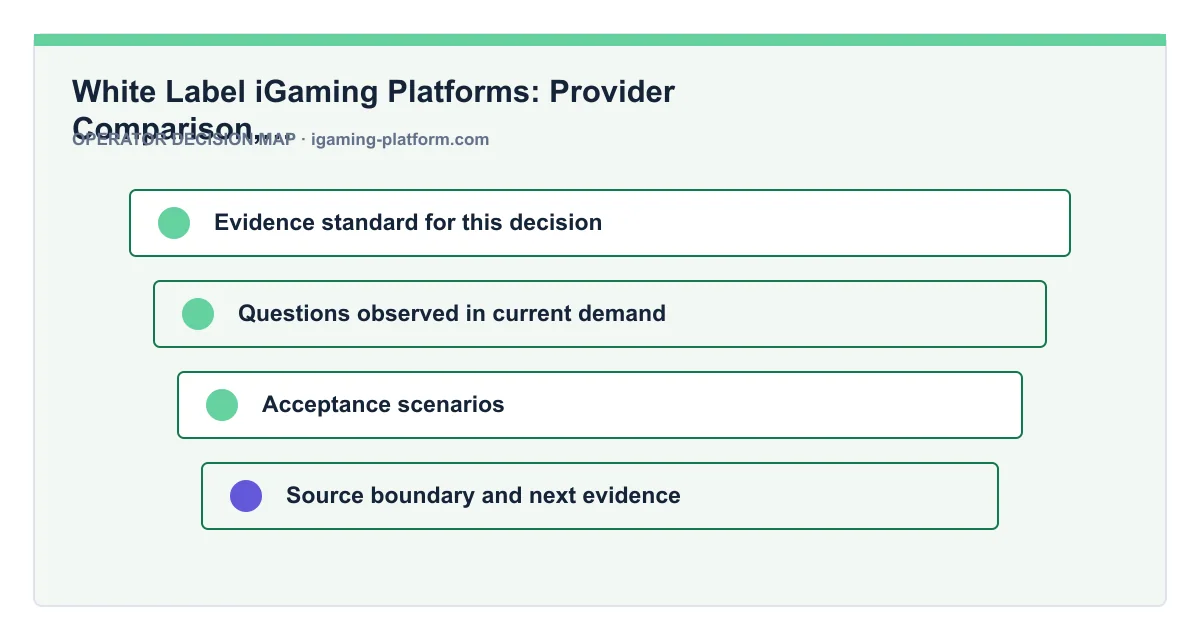
Research-backed decision brief - checked 2026-07-24
White Label iGaming Platforms: Provider Comparison, Revenue Models & Fast-Launch Trade-Offs: the decision-ready answer
A credible implementation answer is a dependency-led plan with owners, entry and exit criteria, evidence gates, data reconciliation, rollback, stabilization, and exit preparation. Supplier timelines remain estimates until scope and prerequisites are fixed.
The assigned US English query white label casino was checked on July 24, 2026. The result included People also ask, so concise answer structure and explicit source boundaries matter for both search and answer engines.
Evidence standard for this decision
Use Yes only when a current source or test explicitly supports the field; Partial when it supports only part of the scope; Not found when the reviewed public sources do not expose it; and Unknown when it has not yet been evaluated. Not found is not evidence that a capability is absent.
| Decision field | Evidence to request | Pass signal | Keep unresolved when |
|---|---|---|---|
| Prerequisites | Decisions, licences, vendors, credentials, environments, and data | Each dependency has an owner and due date | The plan starts with build activities only |
| Acceptance | Business, technical, compliance, operational, and recovery tests | Go-live is blocked by failed critical evidence | Completion is defined as integration available |
| Cutover | Migration, reconciliation, parallel run, rollback, and communications | Abort thresholds and decision owners are rehearsed | Rollback is a sentence rather than a tested plan |
| Stabilization and exit | Hypercare, defect triage, export, deletion, and transition evidence | Operations and replacement paths are usable | The plan ends at launch |
Questions observed in current demand
The questions below combine the assigned search intent with the evidence gaps found in the current page review.
What prerequisites and dependencies determine the White Label iGaming Platforms: Provider Comparison, Revenue Models & Fast-Launch Trade-Offs timeline?
Answer it for a defined operator profile. Compare only like-for-like options, apply one evidence rule, and leave supplier-specific unknowns open until they are closed by current documentation, testing, references, or contract terms.
Question source: archetype - implementation / migration
Which workstreams, owners, gates, and deliverables belong in each implementation phase?
A credible implementation answer is a dependency-led plan with owners, entry and exit criteria, evidence gates, data reconciliation, rollback, stabilization, and exit preparation. Supplier timelines remain estimates until scope and prerequisites are fixed. Apply that evidence rule specifically to White Label iGaming Platforms: Provider Comparison, Revenue Models & Fast-Launch Trade-Offs and keep unverified product, price, market, and performance claims marked as unknown.
Question source: archetype - implementation / migration
What acceptance scenarios and evidence define a pass before production cutover?
A credible implementation answer is a dependency-led plan with owners, entry and exit criteria, evidence gates, data reconciliation, rollback, stabilization, and exit preparation. Supplier timelines remain estimates until scope and prerequisites are fixed. Apply that evidence rule specifically to White Label iGaming Platforms: Provider Comparison, Revenue Models & Fast-Launch Trade-Offs and keep unverified product, price, market, and performance claims marked as unknown.
Question source: archetype - implementation / migration
Acceptance scenarios
- Rehearse cutover with production-scale data and reconcile source, target, wallet, payment, and reporting totals.
- Fail a critical integration during the rehearsal and execute the documented abort and rollback decision.
- Run a bulk export and deletion-evidence exercise while the supplier relationship is still healthy.
Source boundary and next evidence
The linked study is the direct research source for this page's topic cluster. It publishes the sample or control set, field definitions, classifications, checked date, primary-source ledger, limitations, and downloadable data. It does not replace jurisdiction-specific legal advice, a supplier proposal, authenticated documentation, a production test, customer references, or a signed contract.
Read the platform architecture research study or download its CSV dataset.
White label iGaming platforms are designed to help operators launch quickly by leveraging a provider’s existing platform infrastructure, integrations, and operational tooling. For many brands, the white label route reduces time-to-market and lowers the need for an in-house technical team. The trade-off is reduced control over core platform decisions, higher vendor dependency, and limitations that can affect margins and long-term scalability.
This page provides an in-depth comparison of white label iGaming platforms, focusing on provider models, typical limitations, revenue structures, and how to evaluate suitability for rapid market entry.
What “White Label” Usually Means in iGaming
In iGaming, “white label” typically means the brand operates on a provider-controlled platform stack. The provider supplies core systems such as PAM, wallet, game aggregation, payments routing options, reporting, and operational dashboards. The operator runs under its own brand and marketing strategy, but the underlying infrastructure, release cycles, and many technical constraints remain governed by the provider.
White label offerings vary widely. Some are closer to “platform + managed services,” where compliance tooling and operational support are bundled. Others offer a more lightweight setup where the operator primarily receives access to a ready-made platform and predefined integrations.

I’m an iGaming copywriter specializing in high-conversion storytelling for online casinos, sportsbooks, and gaming platforms. I translate complex products, mechanics, and offers into clear, engaging copy that resonates with players while aligning with brand voice and regulatory requirements.
Provider Models & Operational Scope
White label providers generally fall into a few operational patterns. Some offer a full operational package that includes day-to-day support, compliance workflows, and standard reporting. Others provide the platform layer but expect the operator to manage payments, risk, or retention tooling independently through available integrations.
When comparing providers, the most important distinction is whether the operator can influence key operational levers—such as payment routing, bonus logic, player-level controls, and data access—or whether these remain standardized across all white label clients.
Typical Limitations & Where They Matter
White label solutions prioritize speed and operational simplicity, but the constraints are often felt after launch. Limitations usually appear in areas that affect differentiation and margin optimization. Customization is commonly restricted to front-end branding and configuration rather than deep changes to core backend behavior.
Common limitations include:
- Restricted control over core roadmap and release cycles
- Limited flexibility in provider selection (PSPs, KYC, game aggregators)
- Reduced access to raw data and event-level reporting
- Constraints on bonus mechanics and player-level rule customization
These limitations matter most when an operator needs to enter additional jurisdictions, improve payment acceptance rates, or differentiate product mechanics beyond UI and brand positioning.
Revenue Models & Commercial Structures
White label pricing is rarely a single transparent fee. Many arrangements combine setup fees, recurring platform costs, and revenue-linked components such as revenue share or minimum monthly commitments.
The commercial model can significantly affect long-term profitability. Revenue share structures may align incentives early, but they can become expensive as volume grows. Fixed-fee models are more predictable, but may include additional costs for integrations, advanced tooling, or jurisdiction-specific compliance support.
A key evaluation point is how pricing scales with growth, and whether the operator can reduce cost over time by optimizing providers, risk controls, and retention mechanics.
White Label vs Other Models: Comparison
| Decision Factor | White Label | Turnkey | Custom Development |
|---|---|---|---|
| Time to Market | Fast | Fast–Medium | Medium–Long |
| Upfront Investment | Low–Medium | Medium | High |
| Roadmap Control | Low | Medium | High |
| Vendor Lock-In | High | Medium | Low–Medium |
| Customization Depth | Limited | Medium | High |
| Margin Optimization Potential | Medium–Low | Medium | High |
This comparison highlights why white label is often selected for rapid entry, while other models are chosen for long-term differentiation.
Methodology & Evaluation Criteria
This comparison evaluates white label iGaming platforms from the standpoint of fast launch, operational sustainability, and long-term dependency risk.
Providers and offerings are assessed using the following criteria:
- Launch readiness and operational scope included by default
- Integration flexibility for payments, KYC, CRM, and content providers
- Data access, reporting depth, and audit support
- Commercial model transparency and scalability of costs
- Constraints that affect multi-market expansion and differentiation
The goal is to clarify where white label creates strong leverage and where it can introduce structural limitations.
Suitability for Fast Market Entry
White label solutions are commonly chosen for operators who prioritize speed, low operational overhead, and reduced technical staffing requirements. They are often used to validate markets, launch brands quickly, or operate in contexts where standardization is acceptable.
They become less suitable when an operator’s strategy depends on proprietary mechanics, deep optimization of payment routing, unique risk controls, or scaling into multiple regulated jurisdictions where architectural and compliance constraints vary.
Frequently Asked Questions (FAQ)
How is a white label iGaming platform different from a turnkey platform?
White label usually includes provider-controlled infrastructure and often bundled operational services. Turnkey platforms are typically purchased as software that can offer more control, depending on the agreement and deployment model.
Do white label solutions require an in-house technical team?
Usually less than custom or turnkey models. However, operators still need expertise in acquisition, compliance coordination, and performance monitoring.
What are the biggest risks of white label platforms?
Vendor lock-in, limited control over roadmap and integrations, restricted data access, and commercial structures that can become costly as the business scales.
Can a white label operator expand into multiple jurisdictions easily?
Sometimes, but it depends on whether the provider already supports those jurisdictions and can segregate data and compliance requirements effectively.
Are revenue share models always bad?
Not necessarily. They can be attractive for fast launch and low upfront cost, but they should be evaluated based on how they scale as revenue increases.
Concept map
Related concepts and decision guides
- iGaming platform
- Understand the core platform, its operating boundaries, and the architecture decisions that shape an operator stack.
- iGaming Platform System Map
- Assign platform boundaries, systems of record, interface owners, acceptance evidence, and degraded-mode questions.
- turnkey iGaming platform
- Turnkey iGaming platforms are built for operators who want to launch quickly using a pre-assembled, operationally ready software stack.
- iGaming platform development
- Choosing between custom development, turnkey platforms, and white label solutions is one of the highest-impact decisions an iGaming operator will make.
- iGaming platform providers
- Choosing an iGaming platform provider is not just a software decision.
Evidence layer
Primary references and verification limits
Sources were checked on . They support the standards and verification questions used in this guide. They do not prove a supplier-specific price, market eligibility, implementation result, or private product claim; buyers should request current, versioned evidence for those points.
- iGaming Platform - platform architecture research 2026 Original publisher research. A dated methodology, evidence matrix, primary-source ledger, limitations, and downloadable CSV supporting this page's decision framework.
- OWASP Application Security Verification Standard Open application-security standard. Testable web-application security requirements and procurement-ready verification criteria.
- NIST Cybersecurity Framework 2.0 Government standards body. Cybersecurity governance, risk management, protection, detection, response, and recovery outcomes.
- AWS Well-Architected — Reliability Pillar Cloud architecture guidance. Availability targets, resilience testing, incident learning, recovery objectives, capacity, and dependency management.
- UK Gambling Commission — Remote gambling and software technical standards Regulator. Remote gambling software controls, security requirements, player-facing technical controls, and jurisdiction-specific verification questions.
- UK Gambling Commission — Testing strategy for remote gambling software Regulator. Testing, release control, audit evidence, change management, independent review, and production assurance questions.